30% off today$16.95 $11.86·ends tonight
☰✕
Documents
US passport photo2×2 inUSCIS photoGreen card photoUS visa photoDigital photoonline renewalBaby passport photoRequirements
US passport photo requirementsPhoto examples that passFree photo checkerSize & dimensionsBackground rulesGlassesGuides
All passport & visa guidesHow long it actually takes to get a passportRenewing your passport by mail, step by stepApplying for your first passportExpedited passports, honestly explainedWhat a passport actually costsHow it works
How we verifyPricing$11.86Where to get oneMoney-back guaranteeGlasses in a Passport Photo
Short answer
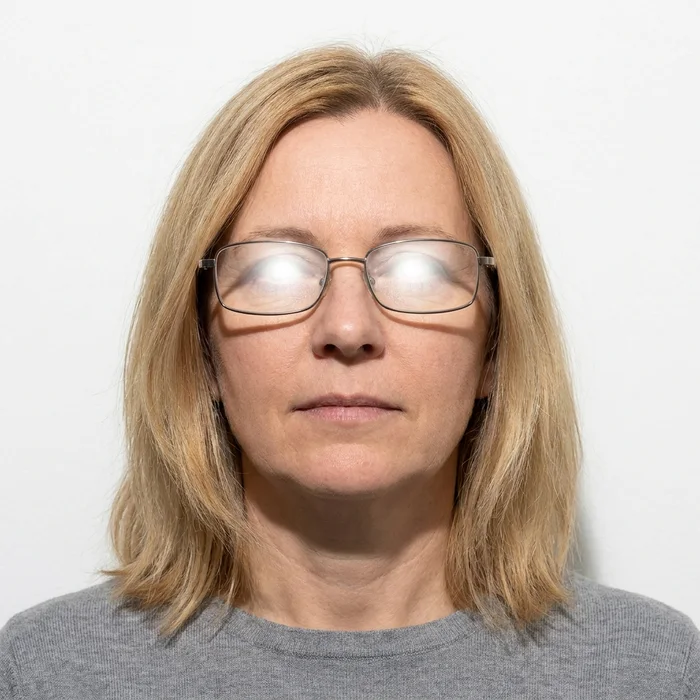
No. Glasses have not been permitted in US passport photos since 1 November 2016. The only exception is medical necessity, and it requires a signed statement from a doctor.
 ✕
✕ ✓
✓Illustrative examples — the people shown are AI-generated.
Why the rule changed in 2016
Before November 2016 glasses were allowed provided there was no glare. In practice that condition failed constantly: reflections from indoor lighting, a frame casting a shadow across an eye, or tinted lenses darkening the iris. The State Department reported that glasses were among the leading causes of photo rejection, and the fix was to remove the variable entirely.
The reason it matters more now than it did twenty years ago is biometric matching. A passport photo is not just a picture for a human to compare — it is measured by facial recognition at automated border gates. Frames crossing the eye region interfere with the landmarks that matching depends on, and a reflection can obscure an iris completely.
This catches people out precisely because passports last ten years. Anyone renewing today whose last photo was taken before 2016 remembers wearing their glasses and being fine.
The medical exception, and what it requires
If you cannot remove your glasses for medical reasons — recent eye surgery, for example — you may wear them, but you must submit a signed statement from a doctor with your application. It is not something you can assert on the form.
Ordinary short-sightedness does not qualify. Nor does discomfort, nor the fact that you always wear them and want the photo to look like you.
What other countries do
The US ban is unusually strict. The UK's guidance says not to wear glasses unless you have to, and if you do, they must not be tinted and your eyes must be free of glare, reflection and shadow. Most of Europe takes a similar line: permitted, conditional, and discouraged in practice.
That distinction matters if you are applying for more than one document. A photo that satisfies a British application may be refused for an American one, even though it is the same face on the same day.
Our checker reflects this. For a US photo, detected glasses are a hard failure that blocks the purchase. Where the rules merely discourage them, it is reported as a warning with an explanation, because blocking a sale over a rule that does not exist would be its own kind of wrong.
If you wear glasses every day
Take them off a few minutes before the photo rather than immediately before. Frames leave temporary indentations on the bridge of the nose and behind the ears, and while those are not grounds for rejection, they are visible for a decade.
Some people worry the photo will not look like them without glasses. Border officers deal with this constantly and it is not a problem — what matters is that your facial features are unobstructed and measurable.
Check your photo against this rule — free
Upload a photo and read the full report on all eleven requirements before paying anything.
Check my photoFrequently asked
Can I wear glasses in a US passport photo?+
No. They have been prohibited since November 2016. The only exception is medical necessity supported by a signed doctor's statement.
What about reading glasses I only wear sometimes?+
Still not permitted. The rule covers all glasses, not only prescription lenses worn constantly.
Can I wear contact lenses?+
Yes. Contacts are fine, including colored ones, provided your eyes remain clearly visible and natural-looking.
What if I wear glasses in my current passport?+
That photo was taken under the previous rule. Your renewal needs a new photo without them.
Are glasses allowed in UK or European passport photos?+
Generally yes, under conditions — no tint, and no glare, reflection or shadow across the eyes. The UK explicitly advises against wearing them unless you need to.