30% off today$16.95 $11.86·ends tonight
☰✕
Documents
US passport photo2×2 inUSCIS photoGreen card photoUS visa photoDigital photoonline renewalBaby passport photoRequirements
US passport photo requirementsPhoto examples that passFree photo checkerSize & dimensionsBackground rulesGlassesGuides
All passport & visa guidesHow long it actually takes to get a passportRenewing your passport by mail, step by stepApplying for your first passportExpedited passports, honestly explainedWhat a passport actually costsHow it works
How we verifyPricing$11.86Where to get oneMoney-back guaranteeHow to Take a Passport Photo at Home
Short answer
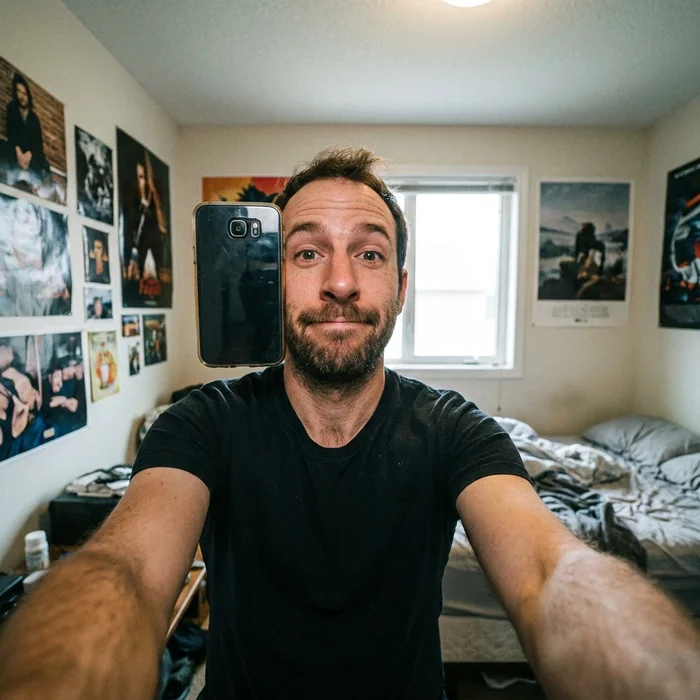
Have someone photograph you from about six feet away, facing a window on an overcast day, against a plain light wall. Distance matters most: a phone at arm's length distorts your features, which is why the official checklist rules out selfies.
 ✓
✓ ✕
✕Illustrative examples — the people shown are AI-generated.
Distance is the thing that matters
A phone held at arm's length sits 40 to 50 cm from your face. At that distance a wide lens enlarges whatever is nearest — your nose — and shrinks what is further away, narrowing the ears and jaw. The effect is subtle enough that you may not notice, and pronounced enough to fail biometric matching.
Two feet removes it entirely. Hand the phone to someone, step back, and zoom in slightly if the framing looks loose — optical distance is what counts, not how large you appear in the frame.
Alone? Prop the phone against a stack of books at the same distance and use the timer, or use the volume button on headphones as a remote. Use the rear camera: it is higher resolution than the front one on every phone, and many front cameras mirror the image by default.
Light: face a window, never use flash
The best light for this is a large window on an overcast day, with you facing it. That gives flat, even illumination across the face with no shadow under the nose or eyes — exactly what the specification wants and what studio photographers spend money to reproduce.
Avoid direct sunlight, which makes people squint and casts hard shadows. Avoid overhead ceiling lights, which pool shadow in the eye sockets and under the nose. Never use flash: it causes red-eye and throws a hard-edged shadow onto whatever is behind you.
Shadows on your own face are the one failure that cannot be fixed afterwards by any software, because the information is simply gone. Everything else — background, framing, color — is recoverable. Get the light right and the rest is mechanical.
Background: stand away from the wall
Find a plain, light-colored wall and stand two to three feet in front of it. The gap is the entire trick: standing against the wall puts your shadow on it, standing away from it lets the shadow fall out of frame or diffuse into nothing.
If you have no suitable wall, it matters less than you would think — our processing separates you from whatever is behind you and composites the required plain background. What it cannot repair is a shadow already on your face.
Pose, expression and how many shots
Square your shoulders to the camera and look straight into the lens with your head level — not tilted, not turned. A neutral expression or a closed-mouth smile, eyes open and not squinting.
Take far more shots than feels sensible. Twenty is not excessive, and thirty is better if you are photographing a child. The entire advantage of doing this at home over a drugstore counter is that attempts are free and nobody is queueing behind you — so use it rather than treating the first frame as the answer.
Check your photo against this rule — free
Upload a photo and read the full report on all eleven requirements before paying anything.
Check my photoFrequently asked
Can I take a passport photo at home?+
Yes. No rule requires a professional photographer — only that the finished photo meets the specification.
How far away should the camera be?+
About six feet. Closer than that distorts your features, which is the reason the official checklist rules out selfies.
Can I use my phone?+
Yes, and the rear camera specifically — it is sharper than the front one and does not mirror the image.
What lighting is best?+
Facing a large window on an overcast day. Avoid direct sun, overhead lights and flash.
What if I do not have a plain wall?+
It matters less than you think, because the background gets replaced. A shadow on your face does not, so prioritise the lighting.